|
Sound Dialogues:
Self-Organization and Transmedia Practices
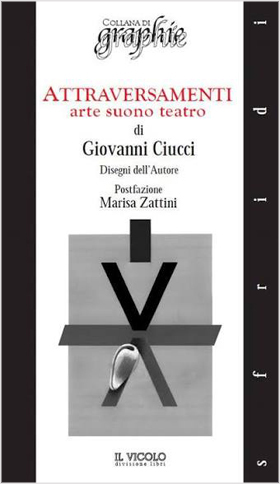
The essay
Attraversamenti develops through a meticulous
analysis of the collaborative dimension found in
specific art experiences that have unfolded since
the opening decades of the twentieth century,
ranging from Futurist and Dadaist performances to
the present day. Giovanni Ciucci, in his dual role
as artist and art theorist, has previously
investigated these themes across various
publications. On this occasion, his inquiry focuses
on the dynamics that establish themselves within
experimental art workshops, including those of his
own conception entitled Play. This
relationship is examined both as a theoretical
category and as a methodological practice,
configuring itself on one hand as a reflection on
the workshop experience carried out, and on the
other as an ongoing quest toward achieving effective
collaborative practice.
Furthermore, the analysis addresses the diverse
operational typologies adopted by those authors
interested in creating collaborative art experiences
open to public contribution. Although certain art
events nominally offer the viewer the opportunity to
become part of a participatory experience—aimed
primarily at soliciting their perceptual
response—Ciucci prefers to rethink this co-belonging
on alternative
grounds. The author thus
intends to reconnect with speculative thought,
according to which receptivity and activity are
originally inseparable in all human action. Drawing
upon the philosophical lesson of Luigi Pareyson,
according to whom the very act of interpreting
already constitutes a profound form of participation,
the essay clarifies that audience engagement needs
not be confined to a purely physical activation, but
can also be realized at an intellectual and
intersubjective level.
In this sense, the workshop horizon is
redesigned by overcoming traditional linguistic and
presentation constraints: the exhibition space and
the theater hybridize into a transmedia synergy that
brings together static and dynamic images, texts,
numbers, and recorded environmental sounds. Within
this complex architecture, the live
performance—entrusted to electric guitars—sees the
musicians act as true performative agents. The
creator of the workshop does not impose a rigid
score or heterodirected tracks: the participants,
fully aware of the meaning of the visual-audio
performance, are called upon a methodical “sound
dialogue” test aimed at verifying the very
possibility of self-organization.
The original nature of the workshop lies precisely
in this radical experimental openness: a genuine
interactive experiment in which the evolution of the
situation remains unpredictable. Although the core
group of performers is deliberately restricted to
preserve the balance of cooperation, the challenge
lies in respecting the presence of the other without
dominating. Within this extended process,
preliminary rehearsals lose their function as a mere
technical stage to be fully integrated into the
realization of the work. During the action, the
musicians decode and interpret the streams on the
main screen, drawing inspiration from the variations
of the video animations in a continuous mirroring
between visual sign and sonic response. The workshop
conceived by Ciucci thus offers itself as an
exercise in deep listening and mutual respect, the
overall outcome of which ultimately flows into a
plurality of devices—from the printed page to web
architectures—configuring the book itself as the
lasting trace and theoretical recontextualization of
an originally ephemeral event.
|
 |