|
Recasting the Book:
From Codex to Multimedia Performance
Publications and
exhibitions regularly highlight the artist’s book—an
object of multifaceted creative possibilities whose
expressions often exceed the conventional
codicological features of the volume. It positions
itself along the boundary merging artwork and
writing, or, more broadly, form, image, structure,
text, and space.
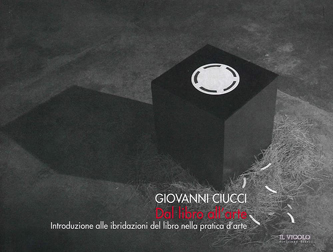
Giovanni
Ciucci’s essay, entitled Dal
libro all’arte, demonstrates an original
conceptual framework compared to what is usually
expected from studies dedicated to these themes. The
title itself indicates the transition of the book
into the artistic sphere; the discussion begins by
analyzing its metamorphosis across millennia,
leading up to the modern book form most familiar to
us. Within this historical development, which
examines the book from a structural perspective, the
most recent typologies are not overlooked: the
digital book, the videobook, and even books created
exclusively for online consumption in their renewed
capacity as multimedia devices. Finally, it is worth
noting that some of the books reproduced and
discussed in the publication were created by the
author of the essay himself, in his dual role as
both artist and art theorist.
The history of the
book, retraced in its fundamental stages throughout
the discussion, clearly demonstrates the succession
of diverse production methods and structural forms.
Some of these are remarkable for their entirely
unique creative outcomes, such as figured
micrography, the carmen figuratum, the
ancient calligram, and grid poetry (versus
intexti). These are aspects that are usually
overlooked, but which the author deliberately
chooses to revisit, in order to conceptualize the
book as a mode of intellectual and practical labor
capable of fostering a dialogue between different
eras—a work, therefore, understood in its
supra-individual and collective significance.
Another key point,
already identified in the preface and addressed in
the first chapter, concerns the re-examination of
the concept of the modern book, namely the one
commonly found in bookstores. According to Ciucci,
this type of book can be considered a shared
reference model, coinciding with the standard
definition found in any ordinary dictionary. This
model, identified as the “book-paradigm”, becomes
the pivot of the entire analysis centered on the
relationship between art and the creation of books
by artists. The various thematic core areas
addressed from time to time revolve around this
concept, as special attention is paid to those
artists—be they writers, poets, or visual
artists—interested in investigating and
reformulating the characteristics of this original
model, through solutions that may sometimes even
compromise its recognizability. Indeed, the book is
not always immediately recognizable in the outcomes
of certain contemporary art practices, as the
book-paradigm itself is called into question for
reasons that vary from case to case.
Among the artistic
creations that align with the book, the essay
examines the poem A Throw of the Dice Will Never
Abolish Chance by the French poet Stéphane
Mallarmé, dedicating a close study to
late-nineteenth-century poetic
experimentation—perhaps suggesting that the birth of
the artist's book can be traced back to this outcome,
even though it is generally situated in the
twentieth century.
The author
intends to delve into a specific number of books in
order to focus more closely on the contents and
motivations of the artists, including Duchamp, Art &
Language, Yves Klein, Agnetti, Latham, and Robert
Morris. In this respect, too, the essay departs from
standard publications in the field, as it privileges
the analysis of the individual book by contrasting
and comparing it with the artist's overall poetics.
For the purposes of investigating the concept of the
book-paradigm, it becomes clear that one must focus
on the artists' own motivations aimed at
reformulating the conventional status of the book.
Artistic experimentation thus leads to solutions
that increasingly diverge from the conventional
book, however varied its text and illustrations may
be.
An additional theme,
rarely addressed in this field, focuses on
contemporary art performance dedicated to book
production. Besides offering the reader an original
perspective for an essay centered on the book, this
approach allows the audience to follow, step by step,
the reflections that guide artistic practice. The
reader can thus engage with what Luigi Pareyson
defines as "formativity" (formatività)—that
is, the ideational and executive process usually
closely guarded by the artist. Indeed, artists often
limit themselves to clarifying the reasons behind
the final outcome, and only sporadically dwell on
the authentic creative path that underlies and
generates the work.
The essay suggests important cultural links that
renew, in terms of content and interpretative
perspectives, the inexhaustible tapestry binding
book and art together. The analysis conducted by
Ciucci in Dal libro all’arte thus leads to a
solid theoretical recontextualization of the
book-paradigm, offering the reader an essential
critical compass for navigating the most radical
experimentations of the contemporary era.
|
 |