|
Excerpt from the
Preface
What role is imagination destined to occupy
within today’s cultural landscape?
This innate gift,
inherent in every human being, reveals itself as an
inexhaustible source of innovation and inspiration—a
driving force capable of charting bold,
unprecedented cultural paths.
The academic world has engaged in fervent debates,
scrutinizing the imagination through the prism of
individual facets, probing its imitative and
creative manifestations, and uncovering its
revolutionary potential in both the sciences and the
arts. This comprehensive exploration challenges the
reductive view of imagination as mere entertainment
or escapism; instead, it recognizes it as a
powerfully transformative force capable of shaping
concrete reality and forging the future. Thus, it is
not a mere reflection of perception, but a titanic
force capable of sculpting worlds out of nothing,
giving life to what lies beyond the veil of tangible
reality: imagination emerges as a potent catalyst,
transmuting the everyday into extraordinary visions.
It urges artists to confront the boundaries of
interpretation and to invoke creative freedom in the
eyes of the beholder. In this vast realm, the latter
rises above the simple replication of the visible,
enriching human experience with layers of meaning
that transcend the common and the known.
Paul Ricoeur, with his prophetic vision, wove
together imagination and action, proclaiming that
nothing great can ever be achieved without the fire
of the former guiding the hand. He views the
imaginative faculty as the beating heart of human
existence—a force that shapes not only our most
instinctive dreams, but the very fabric of our
lives, influencing our interactions and the way we
move through the world.
Far from being a mere trick of the mind or a
transient escape, imagination stands as a catalyst
for change, a bridge between desire and realization,
between the self and becoming—an originary source of
inspiration, free from stylistic precedents and
conditioning, generating an image-presence in a
continuous state of becoming. It calls upon
individuals to reclaim their role as authors of
their own destiny, enabling them to navigate the
vast ocean of possibilities and to grasp stars that
would otherwise remain out of reach. In this
context, art becomes the ultimate laboratory, where
creative freedom, with its baggage of introspection,
knowledge, and interpretation, translates into
tangible expressions that reflect the deepest truths
of human existence.
The artistic dimension liberates itself from the
constraints of tradition, embarking on a bold
exploratory journey along the border between the
visible and the invisible, between reality and
imagination. This creative odyssey, defined as the
"sign-cognitive" approach, transcends the mere
imitation of the real to embrace a less conventional
process, wherein drawing becomes the texture in
which experience and concept, practice and thought,
interweave.
Within this space, the artist, Giovanni Ciucci,
positions himself between sign and meaning, between
color and emotion, inviting the observer into a
dialogue with unexpected forms and spaces—beyond the
boundaries of ordinary interpretation, and
stimulating a personal search for meaning. With
audacity and acumen, the author invites us to
navigate the tumultuous waters of artistic
interpretation, confronting the challenges posed by
formal choices that break with tradition. His vision
transforms uncertainty from an obstacle into the
core of an introspective journey, urging the viewer
to traverse unexplored territories of their own mind
and spirit, armed only with their own rational and
emotional resources. He oversteps the horizons of
knowledge, drawing lines that unite the empirical
world with that of the intellect; he does not rest
content with what has already been seen, but
aspires, rather, to unveil the enigma of metaphor,
to decipher the secret code of images hidden behind
the obvious, and to discover new truths in a
continuous dialogue between what is tangible and
what resides within the abyss of the imaginary. A
personal adventure rich in meaning, in which
ambiguity is transformed into an inexhaustible
source of stimulation and reflection.
Art becomes a battlefield where consciousness and
imagination challenge and merge with one another,
entangling in a generative dance. Here, the artistic
form does not seek definitive answers but poses
questions, opening doors toward the unknown and
stimulating a continuous search for meaning beyond
the boundaries imposed by logic and convention: an
awakening that urges us to break free from the
chains of preconceptions and expectations.
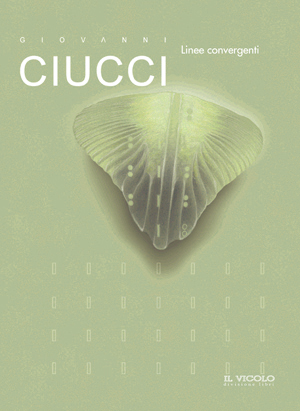
Through his works and his text Linee convergenti,
Ciucci places the individual before the fascination
of the creative act, where every gesture, every
drawn line, is a step toward the revelation of a
broader, deeper, and more authentic world. In this
realm without barriers, the union of imagination and
knowledge does not aim at definitive conclusions,
but opens up to multiple interpretations,
acknowledging the diversity of artistic experiences
that can elude overly restrictive definitions. The
artwork thus becomes a terrain for exploring the
tension between consciousness and inventive impulse,
seeking a balanced dialogue between these elements
and preventing either from overpowering the other.
In Linee convergenti, Ciucci does not
merely propose a new reading of art: he launches a
passionate appeal for an active, participatory
involvement of the observer. This is an art that
does not rest content with being passively admired,
but demands to be lived, questioned, and understood
within a dimension that transcends the visual, so as
to touch the deepest chords of human existence.
Are we still capable of imagining beyond the
boundaries of the Pillars of Hercules?
Ludovica D'Alessandro
|
 |