|
The Perimeter as a
Conceptual Tool for “Discorso Arte”
Artistic
experience unfolds within a relational space where
works, ideas, and interpretations converge and
occasionally diverge, generating new possibilities
of meaning. How can we understand this plurality
without reducing it to rigid criteria or to
definitions of art that claim to operate as absolute
principles, independent of historical and cultural
shifts? This question serves as the starting point
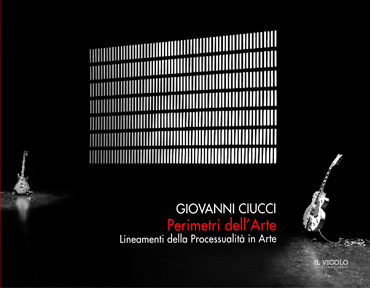
for Giovanni Ciucci’s reflection in Perimetri
dell’arte, which proposes viewing art not merely
as the production of works, but as discorso arte—an
"art discourse" that fosters a process of exchange
among artists, audiences, critics, and all those who
contribute to the construction of its meanings.
At the core of the
essay lies the concept of the perimetro [perimeter],
understood not as a rigid boundary, but as a device
for observation and analysis through which to
interrogate the relationship between the schema
[scheme]—the horizon of thought that accompanies
artistic research—and the schermo [screen],
the concrete manifestation of the artwork itself. It
is within the encounter between these two dimensions
that the work offers itself to perception, prompts
interpretations, and opens up possibilities for
dialogue. The perimetro thus allows for the
consideration of the various phases of artistic
experience: from conception to formation, from
exhibition to reception, and ultimately to the
persistence of the experience in memory, even after
the work has exited the perceptual field.
Engagements
with specific moments in art history—from the
Russian Avant-garde to Neoplasticism—alongside an
examination of the author's own experiences as both
an artist and a theorist, provide opportunities to
explore the analytical capacity of the perimetro
across different historical and operational contexts.
Theoretical reflection thus tests itself through
artistic practice, demonstrating how this device can
be interrogated both in the reading of artworks and
within the processes of making. Contributing to this
research are the mappe mobili [mobile maps],
graphic tools conceived to navigate the multiple
interpretations and evaluations of art, connecting
historical memory with the urgencies of the present
without reducing them to a definitive classification.
Ciucci
develops a proposal aimed at cultivating tools
to comprehend the complexity of art and trace its
transformations, without reducing it to a univocal
and definitive conception. The conceptual
perimetro he outlines offers a perspective for
observation and relational connection, without
erasing differences. The discorso arte—as an
"art discourse"—articulates itself as a shared space,
open to new questions and capable of transforming
through those who participate in it: a process in
which artistic experience continuously generates
dialogue and knowledge.
|
 |